
Brazil is one of the largest economies in Latin America and one of the most watched emerging markets by international investors. For U.S. investors, the country can offer exposure to sectors such as energy, banking, agribusiness, mining, infrastructure, real estate, and natural resources.
But investing in Brazil is not the same as investing in the U.S. market.
Before moving money or buying exposure to Brazilian assets, investors need to understand the available paths, the role of currency risk, local rules, taxes, documentation, market volatility, and the difference between investing through U.S.-listed products and accessing Brazil’s local market directly.
This guide gives you a practical starting point.
BrazilInvestGuide.com is an educational resource created to help international readers understand how the Brazilian investment landscape works. This page does not provide financial, tax, legal, or investment advice.
Can U.S. Investors Invest in Brazil?
Yes, U.S. investors can get exposure to Brazil in different ways.
Some investors use U.S.-listed products, such as Brazil-focused ETFs or ADRs of Brazilian companies. Others explore direct access to the Brazilian market through local financial institutions, brokers, custodians, or regulated structures for non-resident investors.
The best path depends on the investor’s goals, experience, risk tolerance, tax situation, and whether they want simple market exposure or direct access to Brazilian assets.
In general, U.S. investors usually start with one of three routes:
- Brazil-focused ETFs traded in the United States
- Brazilian ADRs available through U.S. markets
- Direct investment through Brazil’s local financial and capital markets
Each route has different requirements, risks, and practical steps.
The Simplest Way to Get Brazil Exposure
For many U.S. investors, the simplest way to get exposure to Brazil is through U.S.-listed investment products.
These may include:
- Brazil ETFs
- Latin America or emerging market ETFs with Brazil exposure
- Brazilian ADRs
- U.S.-listed funds with Brazilian assets
This route is usually easier because the investor can often use an existing U.S. brokerage account. It may also simplify reporting, account management, and custody compared with opening access to the Brazilian local market.
However, this approach also has limitations. A Brazil ETF may not give exposure to every part of the Brazilian economy. ADRs focus only on selected companies. Some sectors, smaller companies, fixed income products, and local opportunities may not be fully represented through U.S.-listed products.
For many beginners, though, this is the most practical place to start learning.
For a broader overview, visit our Brazil ETF Guide and Brazil ADR Guide.
Investing Directly in the Brazilian Market
Some foreign investors want direct access to Brazil’s local market. This may include Brazilian stocks, fixed income products, funds, real estate vehicles, or other local instruments.
Direct access usually requires more preparation.
A foreign investor may need to work with regulated financial institutions, understand non-resident investor rules, complete registration requirements, provide documentation, and follow local procedures for custody, reporting, taxation, and money transfers.
Brazil has a regulated framework for non-resident investors, and official resources from B3 and CVM can help readers understand the general structure. Still, direct investing should not be approached casually. It may require professional support from brokers, tax advisors, legal advisors, or financial institutions familiar with foreign investor rules.
If you are considering direct access to Brazil’s local market, it is important to understand the process before opening accounts or transferring money.
For a broader overview, visit our Foreign Investor Essentials section.
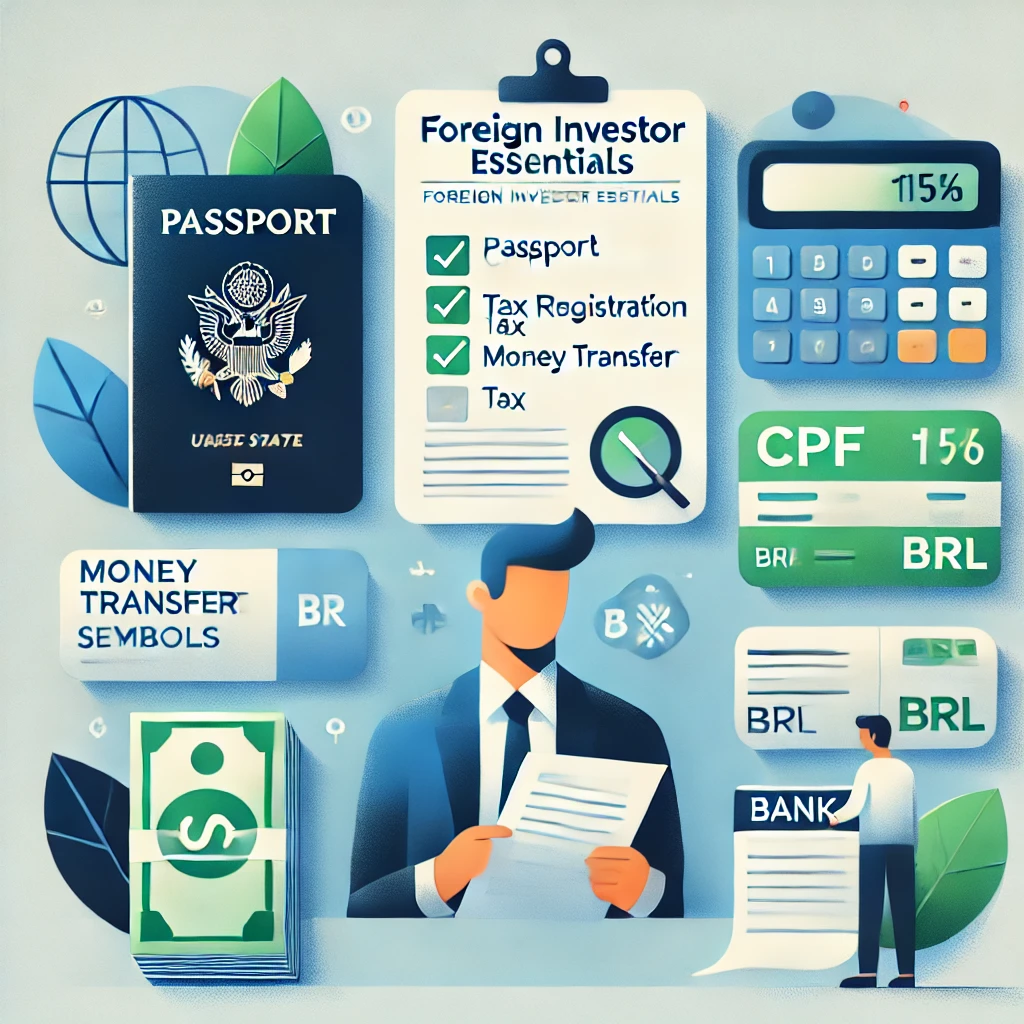
Main Investment Options in Brazil
Brazil offers several investment paths. Each one has a different risk profile, level of complexity, and type of exposure.
Brazilian Stocks
Brazilian stocks give investors exposure to public companies listed on B3, Brazil’s stock exchange. Major sectors include energy, banking, mining, utilities, consumer goods, infrastructure, and agribusiness-related companies.
Some Brazilian companies are also accessible through ADRs in the United States, which may be simpler for U.S. investors who do not want to open local market access.
For a broader overview, visit our section on Brazilian companies and market assets.
Brazil ETFs
Brazil ETFs can give U.S. investors diversified exposure to Brazilian equities through a single product. They may be easier to access through a U.S. brokerage account, but investors should still understand currency exposure, sector concentration, fees, and emerging market volatility.
A Brazil-focused ETF may include large Brazilian companies from sectors such as energy, banking, materials, utilities, and consumer goods. However, ETFs are not always evenly diversified. Some Brazil ETFs may be heavily concentrated in a few large companies or sectors.
For a broader overview, visit our Brazil ETF Guide.
Brazilian ADRs
Brazilian ADRs allow U.S. investors to follow or invest in selected Brazilian companies through U.S. markets. ADRs can be easier to access than direct local shares, but they still carry company-specific, currency, political, and emerging market risks.
Well-known Brazilian companies such as Petrobras, Vale, Itaú, Ambev, and others may be followed by international investors through ADRs or U.S.-accessible market structures.
For a broader overview, visit our Brazil ADR Guide.
Fixed Income in Brazil
Brazil is often watched by global investors because of its interest rate environment. Brazilian fixed income may look attractive when local yields are high, but foreign investors also need to consider inflation, currency risk, taxes, liquidity, and access requirements.
High nominal yields do not automatically mean high real returns for a U.S. investor. If the Brazilian real weakens against the U.S. dollar, currency losses can reduce or even eliminate gains when converted back to dollars.
For a broader overview, visit our section on fixed income in Brazil.
Real Estate
Brazilian real estate may interest foreign investors looking at property, rental income, real estate funds, or long-term exposure to local markets.
However, real estate investing in another country requires careful due diligence. Legal documentation, property registration, local taxes, maintenance, currency conversion, tenant risk, and regional differences can all affect the investment outcome.
Foreign investors should avoid rushing into property deals without local professional guidance.
For a broader overview, visit our section on real estate investing in Brazil.
Investment Funds and Private Opportunities
Some investors may also look at Brazilian investment funds, private equity, venture capital, infrastructure, agribusiness projects, or business opportunities.
These options are usually more complex and may require higher capital, stronger due diligence, professional support, and a clear understanding of legal and tax implications.
For most beginners, it is better to first understand the basic market structure before exploring private or specialized opportunities.
For a broader overview, visit our Investment Options section.
Key Risks U.S. Investors Should Understand
Brazil can offer opportunities, but investors should understand the risks before making decisions.
Currency Risk
Currency risk is one of the most important factors for U.S. investors.
If you invest in Brazilian assets, your return may be affected by changes in the exchange rate between the Brazilian real and the U.S. dollar. Even if an asset performs well in Brazilian reais, your return in U.S. dollars may be lower if the real weakens.
For a broader overview, visit our section on USD/BRL currency risk.
Political and Economic Cycles
Brazil’s market can be influenced by elections, fiscal policy, interest rates, inflation, commodity prices, regulatory changes, and global investor sentiment.
U.S. investors should not look at Brazilian assets in isolation. Brazil is connected to global commodities, emerging market flows, monetary policy, and domestic political decisions.
Tax and Reporting Complexity
International investing may create tax obligations in more than one country.
U.S. investors should consider both Brazilian rules and U.S. tax reporting requirements. Depending on the investment type, income, dividends, capital gains, account structure, and residency status, the tax situation can become more complex.
Always consult a qualified tax professional before making cross-border investment decisions.
For a broader overview, visit our Foreign Investor Essentials section.
Liquidity and Access
Not every Brazilian asset is easy to buy, sell, or understand from abroad. Some investments may have limited liquidity, complex rules, local documentation, or higher transaction costs.
Before investing, understand how you can enter, manage, and exit the investment.
A Practical Step-by-Step Starting Point
If you are new to Brazil investing, use this simple learning path.
1. Learn the Main Investment Routes
Start by understanding the difference between U.S.-listed products, Brazilian ADRs, Brazil ETFs, and direct access to Brazil’s local market.
For a broader overview, visit our Investment Options section.
2. Understand the Role of Currency
Before comparing returns, understand how the Brazilian real and the U.S. dollar can affect performance.
A Brazilian asset can rise in local currency while still delivering a weaker result for a U.S. investor if the exchange rate moves against them. Currency risk is one of the most important parts of international investing.
For a broader overview, visit our section on USD/BRL currency risk.
3. Study the Main Sectors
Brazil has important sectors such as energy, banking, mining, agribusiness, infrastructure, real estate, and technology. Understanding the economy helps you interpret investment opportunities more clearly.
For a broader overview, visit our section on key sectors of the Brazilian economy.
4. Review Companies and Market Assets
Many U.S. investors begin by researching well-known Brazilian names such as Petrobras, Vale, Itaú, Banco do Brasil, Ambev, Brazilian ADRs, and Brazil-focused ETFs.
For a broader overview, visit our section on Brazilian companies, ETFs, and market assets.
5. Understand Legal, Tax, and Transfer Requirements
Before moving money or investing directly, learn about documentation, tax considerations, international transfers, and foreign investor rules.
For a broader overview, visit our Foreign Investor Essentials section.
6. Use Professional Guidance When Needed
Cross-border investing can involve legal, tax, regulatory, and currency considerations. If you plan to invest significant capital, open local accounts, buy property, or access Brazil directly, professional guidance can be essential.
Is Brazil a Good Market for Foreign Investors?
Brazil can be attractive for certain investors, but it is not suitable for everyone.
The country may appeal to investors looking for emerging market exposure, commodity-linked sectors, higher local interest rates, large public companies, or long-term exposure to Latin America’s largest economy.
At the same time, Brazil can be volatile. Currency movements, political changes, inflation cycles, regulation, and market sentiment can affect returns.
A better question is not simply whether Brazil is “good” or “bad” for investors. A better question is:
Does Brazil fit your investment goals, risk tolerance, time horizon, and overall portfolio strategy?
Official Resource
If you want to review official information about foreign investor access to the Brazilian market, visit B3’s English-language page for non-resident investors.
Learn more: B3 — Non-Resident Investor
Continue Learning
If you are just beginning, the best next step is to move through the main sections of BrazilInvestGuide.com in order:
- Start Here
- Investment Options
- Foreign Investor Essentials
- Brazilian Companies & Assets
- Brazil Investment Sectors
- Market Insights
Brazil can be an interesting market to study, but international investing should begin with education, context, and careful research.
Start with the basics, understand the risks, and use the guides on this site to build a stronger foundation before making decisions.